Evaluating the Lily Procreate Stamp Brushes for Digital Floral Illustration
Digital illustration has evolved significantly with the advent of powerful tablet applications, yet the time required to render complex natural elements remains a persistent challenge for artists. For professionals and hobbyists alike, the balance between artistic control and workflow efficiency is critical. This is where specialized asset packs, such as the Lily Procreate Stamp Brushes, enter the conversation. This specific collection offers a targeted solution for creating lily-themed artwork within the Procreate ecosystem, providing a pre-made library of botanical elements that can accelerate the design process without sacrificing aesthetic quality.
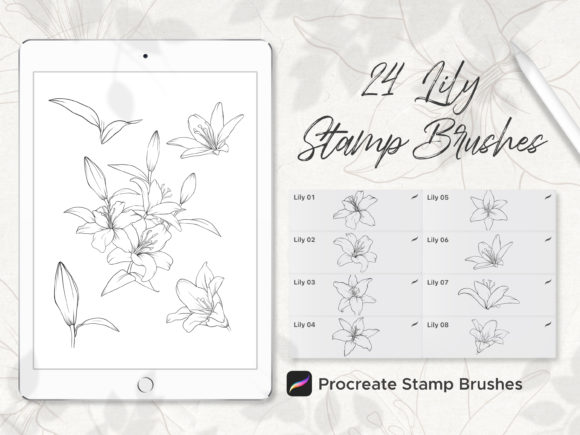
Understanding the value of this tool requires looking beyond the surface level of "stamps." While some digital artists prefer building every petal and stem from scratch using basic round brushes, others recognize the utility of high-quality stamps for background work, pattern design, or rapid prototyping. The Lily Procreate Stamp Brushes set is distinct because it focuses exclusively on one flower type, offering depth rather than breadth. Instead of a generic "flower pack" containing twenty different species with limited variations, this set provides twenty-four unique stamps dedicated entirely to the lily, ensuring consistency in style and lighting across a project.
Deconstructing the Asset Library
The core of this product lies in its specific composition. The package includes a single .brushset file delivered within a zip archive, designed for seamless installation into Procreate version 5.0 or higher. Once installed, the user gains access to a curated triad of elements: eight distinct lily flower stamps, eight lily bud stamps, and eight lily leaf stamps. This balanced distribution is intentional. In botanical illustration, a scene rarely consists of fully bloomed flowers alone; the lifecycle stages represented by buds and the structural support provided by leaves are essential for creating a believable composition.
The inclusion of twenty-four unique variations addresses a common pitfall of lower-quality stamp sets: repetition. When an artist uses a stamp tool repeatedly, identical patterns can become obvious to the viewer, breaking the illusion of a hand-drawn piece. By offering eight variations for each category, the Lily Procreate Stamp Brushes allow for enough randomness to maintain visual interest. An artist can layer multiple leaf stamps to create a dense foliage background or combine different bud angles to suggest growth direction, all while maintaining a cohesive artistic voice.
Workflow Efficiency vs. Custom Drawing
When evaluating whether to incorporate stamp brushes into a workflow, the primary consideration is the trade-off between speed and customization. Traditional methods involve sketching, lining, coloring, and shading every element individually. This approach offers maximum control over every curve and gradient but is undeniably time-consuming. In contrast, utilizing the Lily Procreate Stamp Brushes shifts the focus from creation to composition. The artist spends less time rendering the anatomy of the flower and more time arranging the elements, adjusting colors, and integrating the flora into the broader narrative of the artwork.
This distinction makes the set particularly valuable for specific use cases. For instance, surface pattern designers who need to create seamless repeats for textiles or wallpaper benefit immensely from having consistent, high-quality elements that can be rotated and scaled quickly. Similarly, social media content creators who need to produce daily illustrations may find that these stamps provide the necessary polish without the hours of labor associated with full manual rendering. However, for fine art pieces where every brushstroke must be unique and expressive, these stamps might serve better as an underpainting guide or a base layer to be painted over, rather than the final output.
Technical Compatibility and Limitations
A crucial factor in adopting any digital resource is compatibility. The Lily Procreate Stamp Brushes are engineered specifically for the Procreate app on iPad, requiring version 5.0 or later. This specificity is both a strength and a limitation. For users deeply embedded in the Apple ecosystem, the integration is flawless; the brushes inherit Procreate's pressure sensitivity settings, streamline blending modes, and respond intuitively to gesture controls. The .brushset format ensures that all twenty-four stamps are organized neatly within the app's interface, ready for immediate use.
Conversely, this exclusivity means the assets are not transferable to other popular digital painting platforms such as Adobe Photoshop, Clip Studio Paint, or Affinity Designer. Artists who work across multiple devices or software suites will find that these stamps cannot be directly imported elsewhere. While it is sometimes possible to export a stamped image as a PNG and import it into another program as a custom shape, this defeats the purpose of having a dynamic brush tool that allows for color changes and texture adjustments on the fly. Therefore, the decision to purchase this set should be weighed against the user's primary software environment.
Comparative Analysis: Niche Sets vs. General Bundles
In the marketplace of digital art resources, consumers often face a choice between massive "mega-bundles" containing thousands of brushes and niche, specialized sets like the Lily Procreate Stamp Brushes. Mega-bundles offer variety and the allure of having "everything," but they often suffer from quality inconsistency. A bundle might include fifty flower types, but each may lack the detailed texturing or anatomical accuracy found in a dedicated set.
The specialized nature of this lily collection suggests a higher degree of attention to detail. Because the creator focused on a single subject, the lighting direction, edge softness, and color gradients across the flowers, buds, and leaves are likely harmonized. This consistency is difficult to achieve when pulling elements from a general garden pack where roses, sunflowers, and daisies might have been drawn at different times with different techniques. For projects requiring a monochromatic or specific floral theme, the focused approach of the Lily Procreate Stamp Brushes often yields a more professional result than cherry-picking from a vast, disjointed library.
Ideal Scenarios for Implementation
Determining when to utilize these stamps involves assessing the project goals. They are an excellent fit for:
- Rapid Prototyping: Quickly mocking up layout ideas for greeting cards or invitations to see how floral elements interact with typography.
- Background Textures: Creating subtle, organic backgrounds for web design or UI mockups where hand-drawn details add warmth without distracting from the main content.
- Educational Content: Teachers or workshop leaders demonstrating composition principles without getting bogged down in the technicalities of drawing botany from scratch.
- Hybrid Workflows: Artists who paint manually but use stamps for repetitive elements like distant foliage or filler flowers to save time.
However, there are scenarios where alternative solutions might be preferable. If an artist's goal is to learn the fundamental structure of lilies for anatomical study, relying solely on stamps may hinder skill development. In such cases, using reference photos and basic brushes to construct the flower manually would be more beneficial educationally. Additionally, if a project requires a highly stylized, abstract, or non-realistic interpretation of a lily that deviates significantly from the realistic style of the stamps, the pre-made assets might require too much modification to be useful.
Making an Informed Decision
Ultimately, the value of the Lily Procreate Stamp Brushes depends on the individual artist's needs and workflow preferences. It is not a replacement for foundational drawing skills, but rather a strategic tool to enhance productivity and expand creative possibilities. The set's strength lies in its specificity and the logical breakdown of the plant into flowers, buds, and leaves, allowing for versatile composition.
Before integrating this tool, artists should consider their current software setup, ensuring they are running Procreate 5.0 or above, and reflect on whether their typical projects benefit from accelerated asset placement. For those who frequently incorporate botanical motifs into their work, having a reliable, high-quality library of lily elements can significantly reduce production time while maintaining a high standard of visual appeal. As with any digital resource, the best approach is to view it as part of a larger toolkit—complementing manual techniques rather than replacing them entirely—to achieve the most dynamic and engaging results.