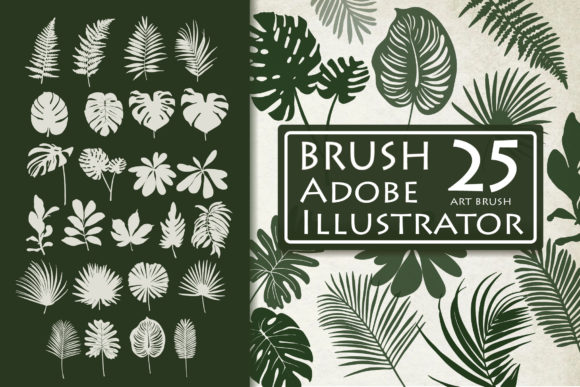
Evaluating the Set of Brushes for Adobe Illustrator and Pattern Collections
For graphic designers, illustrators, and digital artists working within the Adobe ecosystem, the efficiency of their workflow often hinges on the quality and versatility of their toolset. A Set of Brushes for Adobe Illustrator, particularly one focused on pattern brushes, represents a significant resource for expanding creative possibilities without starting from scratch. This evaluation examines a specific collection comprising 30 pattern vector brushes, designed exclusively for Adobe Illustrator, to help potential users determine if it aligns with their project requirements and artistic goals.
Understanding the Asset Composition
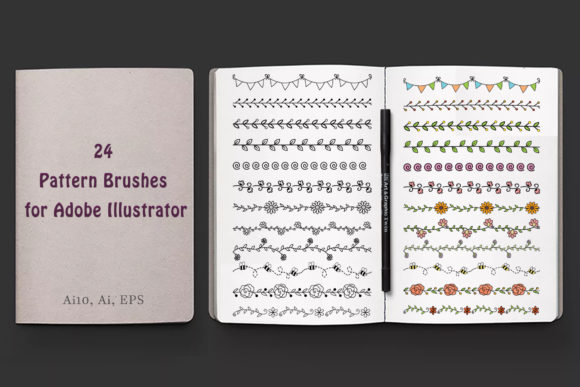
Before integrating any new asset into a professional workflow, it is essential to understand exactly what is included in the package. This specific set is structured to provide flexibility across different stages of the design process. The core of the collection is an Illustrator AI 17.0 vector file containing 30 fully functional pattern brushes. These are not merely static images but dynamic tools that can be applied to paths, allowing for seamless repetition and scaling along a stroke.
In addition to the ready-to-use brush file, the package includes an Illustrator EPS 10 vector file. This file contains the 30 black vector elements that constitute the source art for the brushes. Having access to these raw elements is crucial for designers who may need to modify the underlying shapes, adjust anchor points, or repurpose the graphics for uses other than brushing. Furthermore, the inclusion of a PNG file at 300dpi with the 30 black elements on a transparent background offers immediate utility for raster-based workflows or quick mockups where vector editing is not required.
Reasons for Interest and Potential Applications
Designers often seek out a specialized Set of Brushes for Adobe Illustrator to overcome creative blocks or to accelerate production timelines. Pattern brushes, in particular, are invaluable for creating borders, frames, decorative dividers, and intricate linework that would be time-consuming to draw manually. This collection of 30 distinct patterns provides a diverse library that can be applied to branding projects, packaging design, textile patterns, and editorial illustrations.
The primary appeal lies in the balance between readiness and customizability. While the brushes are pre-made, the inclusion of the EPS 10 source files means the user is not locked into the original design. If a specific element needs to be thickened, simplified, or combined with another shape, the vector data allows for such modifications. This dual nature—ready-to-apply yet editable—makes the set attractive for both junior designers looking to learn how pattern brushes are constructed and senior artists needing reliable assets for client work.
Benefits and Workflow Efficiency
Integrating this set into an existing library offers several tangible benefits. First, it standardizes the quality of decorative elements. Since all 30 brushes are created within a cohesive style, they ensure visual consistency across a single project. Second, the use of vector brushes ensures scalability. Unlike raster brushes that may pixelate when enlarged, these pattern vector brushes maintain crisp edges at any size, which is critical for large-format printing such as banners or vehicle wraps.
The file compatibility is another significant advantage. By providing an AI 17.0 file, the set remains accessible to a wide range of Adobe Illustrator versions, ensuring that users with slightly older software installations can still utilize the tools effectively. The EPS 10 format further extends this compatibility to other vector editing software that supports the Encapsulated PostScript standard, although the primary functionality as interactive brushes is reserved for Illustrator.
Considerations and Tradeoffs
While the benefits are clear, there are tradeoffs and considerations that buyers must evaluate. The most notable limitation is the exclusivity to Adobe Illustrator. Users working primarily in Affinity Designer, CorelDRAW, or open-source alternatives like Inkscape will find the AI brush file unusable in its native format. While the EPS and PNG files offer some cross-platform utility, the interactive "brush" functionality—where the pattern flows along a path—is lost outside the Illustrator environment.
Additionally, the aesthetic style of the 30 black vector elements may not suit every project. The elements are provided in black, which is standard for brush creation, but the specific artistic style (e.g., hand-drawn, geometric, organic) needs to match the designer's current direction. If the style is too niche, the user may spend more time modifying the vectors than simply applying them. Therefore, reviewing the preview images thoroughly before acquisition is a necessary step to ensure stylistic alignment.
Ideal Use Cases
This Set of Brushes for Adobe Illustrator is a strong fit for specific scenarios. It is highly recommended for branding agencies that frequently need to create custom borders and seals for logos and stationery. It is also well-suited for surface pattern designers who need to quickly generate repeating motifs for fabrics or wallpapers. Educators teaching vector illustration techniques will also find value in the EPS 10 source files, using them as case studies to demonstrate how complex patterns are built from simple vector shapes.
Furthermore, freelancers managing tight deadlines will benefit from the time-saving aspect. Instead of drawing a decorative frame from scratch, they can apply a brush from this set, adjust the stroke weight, and expand the appearance if necessary to tweak individual segments. The high-resolution PNGs also serve web designers who need quick decorative assets without loading heavy vector scripts on a webpage.
When to Consider Alternatives
There are situations where alternatives may be worth considering. If a designer requires a vast library of hundreds of brushes covering multiple styles (watercolor, charcoal, ink), a single set of 30 pattern brushes might feel limited. In such cases, comprehensive subscription services or larger mega-bundles might offer better variety. Similarly, if the workflow is strictly raster-based, such as digital painting in Photoshop or Procreate, investing in vector brushes for Illustrator would be inefficient; native raster brush sets for those platforms would be a more logical choice.
Moreover, if a project demands highly specific, custom-drawn elements that define a unique brand identity, relying solely on pre-made brushes—even editable ones—might result in a generic look. In these instances, commissioning a custom brush set or drawing elements from scratch ensures total uniqueness, though at a higher cost of time and money.
Making the Decision
Ultimately, deciding whether to incorporate this Set of Brushes for Adobe Illustrator depends on the intersection of your software environment, project needs, and desire for customization. If you are an Illustrator user seeking to enhance your decorative capabilities with scalable, editable vector tools, this collection offers a practical solution. The inclusion of source files and high-resolution previews adds significant value, allowing for informed evaluation and flexible application.
By weighing the convenience of pre-made patterns against the need for stylistic specificity and software compatibility, designers can make a reasoned choice. For those whose work involves frequent creation of borders, frames, and repetitive linear designs, this set serves as a robust addition to the digital toolkit, bridging the gap between manual drafting and automated efficiency.